TB in San Quentin State Prison
(1864-1938)
California's prison system was established at the peak of the Gold Rush.
San Quentin State Prison, located north of San Francisco, was the first Prison in the State.
- Information and graphs come from Dr. Stanley's report
"Tuberculosis in San Quentin;" (1938); California and Western Medicine. Retrieved from the National Library of Medicine. -
1858-1873
* 1858 (inmate population: 582)
Dr. Taliaferro writes, “men, when locked up, are literally piled one upon another, this fills the room with animal heat and impure air. The mornings are cold and chilly when the men are called out to work. Sudden transitions from heat to cold, with their bodies much relaxed and debilitated by the heat and impure air, renders them very susceptible to pulmonary diseases” (Stanley, 1938). There were 3 cases of TB that year.
* 1873 (inmate population: 916)
"They are locked up for 13 to 14 hours a day, sleeping and living in a fetid and illy ventilated atmosphere, made absolutely poisonous by exhalations from diseased lungs and unwashed surfaces [...]" When a fire broke out in February 1876, 500 prisoners were confined 24 hours a day.
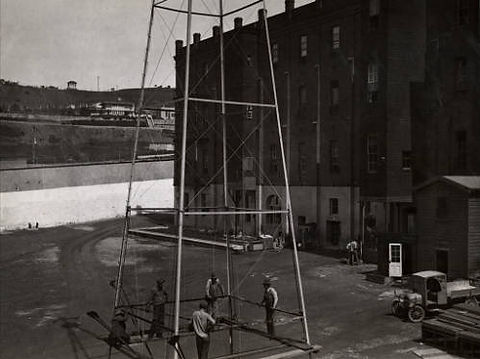
Image on the right: "A light tower in the lower yard of San Quentin State Prison, Marin County, California, circa 1915.
(Marin Public Library, Anne T. Kent Collection.)

1880-1904
* 1880 (inmate population: 1500)
A new Prison was built at Folsom.
* 1885 (inmate population: 1180)
Of a total of 29 deaths that year, 18 died of pulmonary disease.
* 1904 (inmate population: 1494)
Dr. Casey states that about 50% of total deaths were due to TB. He blamed "bad ventilation, causing the air to be full of fine particles of dust, which injure the air passages, leaving a fertile field for the tubercle bacillus."
Image on the left: "Communal dining area of San Quentin State Prison," Marin County, California, circa 1915.
(Marin Public Library, Anne T. Kent Collection.)
Dr. Stanley
In 1913, Dr. Leo Stanley was appointed resident doctor at Saint Quentin State Prison. He reports the conditions of the prison conditions when he first arrived: “The ventilation was abominable, the beds were crowded together, air space was extremely limited, [there were] a few old-fashioned windows, low and narrow, let in a very little light,” San Quentin lacked the "essentials for cure: light, air” and lack of sanitary conditions.
Image on the right: Dr. Leo Stanley and his wife, circa 1915. She died of TB in 1926. (Marin Public Library, Anne T. Kent Collection.)
(Marin Public Library, Anne T. Kent Collection.)


TB hospital at San Quentin
In 1913, tuberculosis was the main cause of death in the prison.
With the help of the Board of Prison Directors, Dr. Stanley built an open-air hospital of 4,800 sq. feet, with sun areas, large windows, and no bars. At the first symptom of TB, inmates were sent to the hospital where they were screened.
Because of the improvements, in 1915, the Board of Prison Directors decided to send all TB patients from Folsom prison to San Quentin. In that year, about 40 inmates with TB were transferred.
In 1934 there was a peak in the prison population with 6400 inmates, making it the most populous it had ever been.
In that year, an entire new hospital was built, where the 4th floor was an open-air TB hospital.
Image on the left: "Tuberculosis ward at San Quentin State Prison, circa 1915." Dr. Leo Stanley Collection. (Marin Public Library, Anne T. Kent Collection.)
"Tuberculosis in San Quentin - Stanley" 1938

"Tuberculosis in California is decreasing" - 1917

Retrieved from the National Library of Medicine
Calexico Chronicle, Volume 6, n. 192. 22 March 1917. Retrieved from CDNC.